
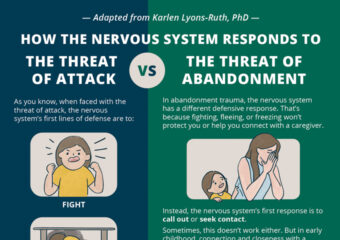
We know that in the face of threat, the nervous system responds in ways designed to help keep us safe. For example, if your client was under physical attack, their nervous system may have gone into fight, flight, or freeze. But of course, that’s only one type of threat. And the responses that might be […]
[Infographic] 4 Signs of the Attach/Cry-for-Help Response
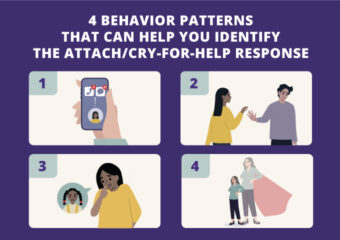
When people are in distress, seeking out the support and comfort of others can be a natural response. But for clients who’ve experienced trauma, this response can sometimes signal something more. Their persistent attempts to elicit help from others may indicate that they’re stuck in the attach/cry-for-help response. So how can we better recognize this […]
[Infographic] 4 Questions to Help Clients Overcome Anxiety
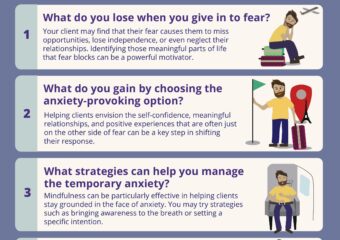
When clients experience anxiety, their first response is often to avoid whatever (or whomever) might be causing it. But when clients become trapped in a cycle of avoidance, it can keep them from the very activities and people they value most. So how can we help clients see the cost of their avoidance strategies – […]
Why Mind-Wandering Can Be a Detriment to Happiness (and One Way to Refocus)

When a person’s thoughts start to stray, they can tend to go in one of two directions. Sometimes people find themselves dreaming of an upcoming vacation or looking forward to a get-together with friends . . . . . . or, maybe they’re distracted by worries about approaching deadlines or unpaid bills. Even though the […]
Could Stronger Resilience Promote Better Health?

Could greater resilience reduce a person’s need for health care services? James E. Stahl, MD, MPH, and a team of researchers at the Massachusetts General Hospital Benson-Henry Institute (BHI), noted that poor psychological and physical resilience is often associated with an increased use of healthcare services. Since research consistently shows that mind-body interventions can be […]