

Now that we’ve wrapped up the Advanced Master Program on the Treatment of Trauma, I’d like to take a moment to thank you again for tuning in. We believe the leading research and developments on trauma treatment are so important. That’s why we made it our mission to make this program available to as many […]
[Infographic] How Trauma Can Affect Adult Relationships
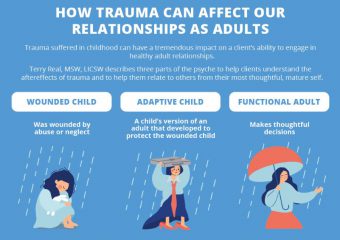
Left untreated, childhood trauma can reverberate through adult relationships and make it difficult for your client to get close to other people. But Terry Real, MSW, LICSW has a way of thinking about the psyche that can help clients understand the aftereffects of trauma . . . . . . and help practitioners retarget their […]
Treating Trauma: How to Work with the Shame of Moral Injury

When a client experiences a moral injury, the guilt, sadness, and shame that come with it can be debilitating. It can create a deep wound at the center of a person’s identity. So how can you help a client who’s suffering from a moral injury begin to heal? In the video below, Ruth Lanius, MD, […]
[Infographic] How to Differentiate Between the Freeze and Shutdown Trauma Responses
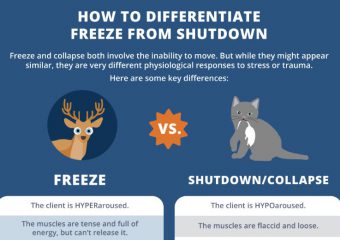
The freeze and shutdown responses to trauma can resemble each other . . . . . . but they are very different in terms of what’s happening in your client’s brain, body, and nervous system. And that means they require different grounding strategies as well. In this infographic, we lay out some key cues to […]
A Mistake Practitioners Might Make When Their Patient Is Stuck in the “Attach/Cry-for-Help” Response

We know fight, flight, and freeze . . . . . . but recently the experts have identified several more defense responses to trauma, including “attach/cry-for-help.” This response is potentially the least understood, and it can be challenging to work with. And according to Kathy Steele, MN, CS, there’s a common mistake that practitioners make […]
A Simple Strategy for Dissociative Clients Who Lose Time

When a client dissociates in session, there are many grounding techniques we can use to bring them back to the present. But what can help clients when they dissociate outside of your office – particularly when they report losing chunks of time? Below, Ruth Lanius, MD, PhD shares a simple yet effective strategy that helps […]
[Infographic] Working with Structural Dissociation
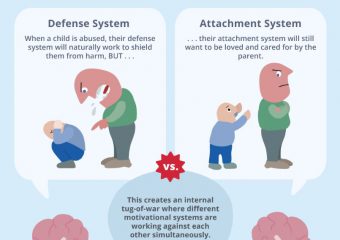
One challenge of working with trauma is when a patient’s dissociated “parts” are operating independently . . . . . . or worse, they’re at odds with each other. This can be very distressing for the patient (and lead to a dysregulated nervous system). But the Structural Dissociation Model developed by Kathy Steele, MN, CS, […]
The Differences in Dissociation Triggered by Shame and Terror – and How to Work with Each

Some of our most challenging work is with clients who have suffered from trauma – and when a client dissociates, that work can become even more complex. The way we approach a client’s dissociation may vary based on what triggered it. In the video below, Bethany Brand, PhD, will share the clues she looks for […]
Working with the Nervous System via Telehealth

For many practitioners, it’s been months since they’ve seen patients in person. Telehealth has been critical during the pandemic, but it also comes with some challenges – not the least of which is working with your patient’s nervous system through a screen. In the video below, Deb Dana, LCSW will walk you through how she […]
What We Might Be Missing – Listening for Racial Stress in Session

There may be times when a client comes into a session with a specific story about racism that they experienced, and they want to talk about it. But according to Usha Tummala-Narra, PhD, a client’s experience of racial stress will usually come up much more subtly – and it could be easy to miss if […]