
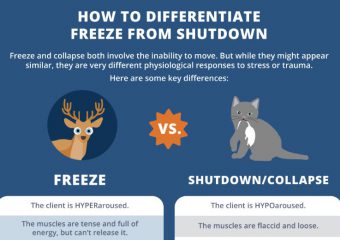
The freeze and shutdown responses to trauma can resemble each other . . . . . . but they are very different in terms of what’s happening in your client’s brain, body, and nervous system. And that means they require different grounding strategies as well. In this infographic, we lay out some key cues to […]
[Infographic] Working with Structural Dissociation
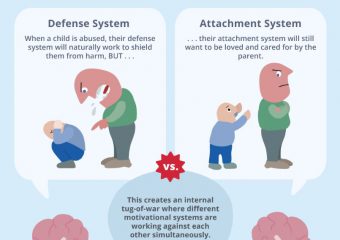
One challenge of working with trauma is when a patient’s dissociated “parts” are operating independently . . . . . . or worse, they’re at odds with each other. This can be very distressing for the patient (and lead to a dysregulated nervous system). But the Structural Dissociation Model developed by Kathy Steele, MN, CS, […]
[Infographic] Four Core Strategies for Managing Stress and Anxiety
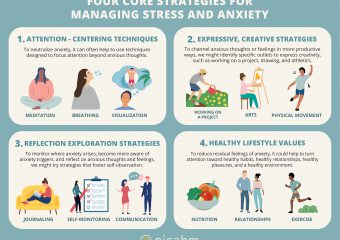
For many clients, anxiety can be crippling – it often stifles their personal and professional growth, shuts down their ability to form relationships, and sometimes even takes a toll on their physical health. So how can we help clients disrupt the exhausting cycle of anxious thoughts and feelings? Below, we created a free tool based […]
[Infographic] A 5-Step Process for Transforming Shame with Self-Compassion
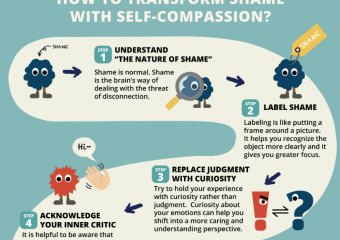
As practitioners, we know how transformative self-compassion can be – especially when it comes to healing shame. But here’s the thing – when a client is deeply rooted in shame, the very idea of being kind to themselves can feel undeserved and uncomfortable, even unnatural. So what if we could give them a step-by-step process […]
Applying the 3 Circles Model of Emotion to Help Clients Heal Shame [Infographic]
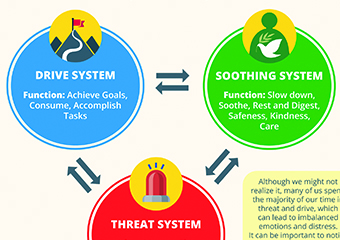
According to Paul Gilbert, PhD, we have three types of emotion regulation systems – we’ve got the Threat System, the Drive System, and the Soothing System. Now when a client is stuck in a painful cycle of self-criticism and shame, it’s often because these three systems are out of balance. You see, many clients spend […]