
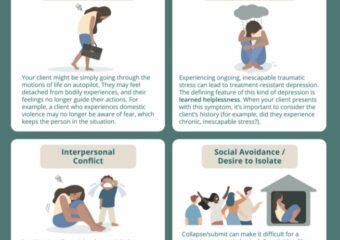
Like many of the emerging defense responses to trauma, the collapse/submit response can be difficult to recognize. So to give you a clearer idea of what this trauma response can look like, we created this free infographic that highlights four key ways it might present in a client. To put this infographic together, we gathered […]
Is Your Patient “Feeling” Unworthy? What May Be the Underlying Cause, with Janina Fisher, PhD
Trauma can leave a patient with a deep sense of unworthiness. On top of that, your client might even blame themselves for feeling this way. But as we know, there’s always a purpose behind a patient’s response to trauma. And sometimes, the challenge is getting your patient to see the wisdom behind their response – […]
[Infographic] – Three Warning Signs of Structural Dissociation
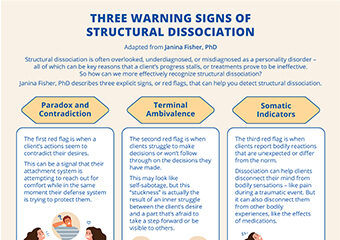
Working with structural dissociation can be critical in the treatment of severe or prolonged trauma . . . . . . but it’s often difficult to detect. According to Janina Fisher, PhD, structural dissociation is commonly underdiagnosed, or it’s misdiagnosed as a personality disorder. And when left undetected, it could lead to ineffective treatments that […]
A Three-Step Approach to Treating Trauma-Related Dissociation, with Thema Bryant, PhD

Dissociation can be tricky to spot. On top of that, it can look awfully similar to freeze or shutdown. And to complicate things further, a patient might dissociate when they’re in either one of those trauma responses. But being able to detect when a client is dissociating is critical for providing effective treatment. So in […]
What’s Happening in the Nervous System of Patients Who “Please and Appease” (or Fawn) in Response to Trauma? With Stephen Porges, PhD
You’ve probably heard of fight, flight, and even the freeze response to trauma. But there are some newer defense responses – ones that experts have only recently begun to name and understand – that are critical to our clinical work. One of those defense responses is “please and appease.” You may have also heard expert […]
[Infographic] – How the Nervous System Responds to Trauma
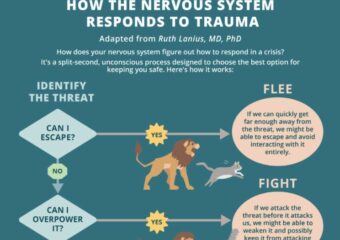
It can often be difficult for trauma survivors to understand how or why they reacted a certain way during a traumatic experience. Instead of seeing their trauma response as the result of a split-second, unconscious decision made by their nervous system, your client may blame themself for not reacting differently. This can be especially true […]
Understanding Trauma Triggers, with Stephen Porges, PhD

In the aftermath of trauma, some clients struggle to feel a sense of connection to their bodies. And when clients can’t properly interpret the sensations or messages that the body is sending to the brain, it can be very difficult for them to get a handle on their triggers. So in the video below, Stephen […]
Working with Emotional Distress – with Janina Fisher, PhD

When it comes to treating trauma, we’re often working with clients who have a low tolerance for distress. And when faced with traumatic memories or difficult emotions, they may respond by slipping into a state of hypoarousal to defend against the pain. So in the video below, Janina Fisher, PhD shares how she helps hypoaroused […]
Treating Trauma: Strategies to Help Clients Feel Safe

Trauma can rip away a client’s sense of safety . . . . . . and leave them with a nervous system that is primed to detect threats. That’s why as practitioners, it’s so important that we have strategies to build a client’s feelings of safety before we help them process traumatic memories. So in […]
Helping Clients Talk About Shame

When Clients are Reluctant to Talk About Shame Working with clients who suffer from deep feelings of shame can be a delicate and nuanced process – for a few reasons . . . To start, shame can disguise itself in a number of ways. It can hide beneath anger, outrage, self-sabotage, or abusive relationships. What’s […]