• Skip to primary navigation
  • Skip to main content
  • Skip to primary sidebar

NICABM home pageNICABM

Better outcomes. More quickly.

  • Home
  • Courses
  • Experts
  • Blog
  • Contact
  • Log In

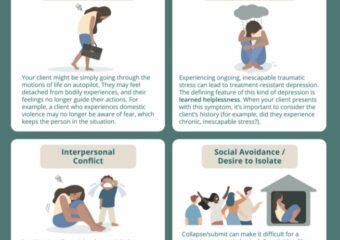
[Infographic] – Four Key Ways Collapse/Submit Can Present in a Client

19 Comments

How the collapse and submit trauma response can present in a client in therapy

Like many of the emerging defense responses to trauma, the collapse/submit response can be difficult to recognize. So to give you a clearer idea of what this trauma response can look like, we created this free infographic that highlights four key ways it might present in a client. To put this infographic together, we gathered […]

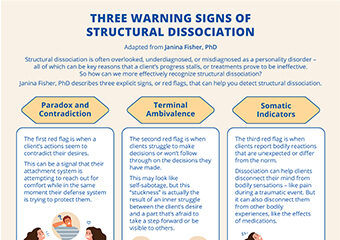
[Infographic] – Three Warning Signs of Structural Dissociation
53 Comments

Working with structural dissociation can be critical in the treatment of severe or prolonged trauma . . . . . . but it’s often difficult to detect. According to Janina Fisher, PhD, structural dissociation is commonly underdiagnosed, or it’s misdiagnosed as a personality disorder. And when left undetected, it could lead to ineffective treatments that […]

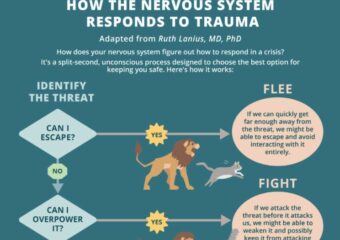
[Infographic] – How the Nervous System Responds to Trauma
57 Comments

The Nervous System's Response to Trauma and Fight, Flight, Freeze, Shutdown in Therapy

It can often be difficult for trauma survivors to understand how or why they reacted a certain way during a traumatic experience. Instead of seeing their trauma response as the result of a split-second, unconscious decision made by their nervous system, your client may blame themself for not reacting differently. This can be especially true […]

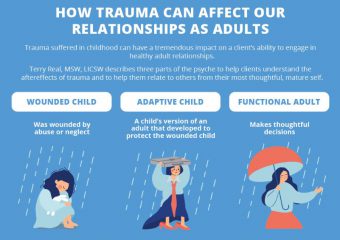
[Infographic] How Trauma Can Affect Adult Relationships
64 Comments

The Impact of Trauma on Adult Relationships Infographic Adapted from Terry Real

Left untreated, childhood trauma can reverberate through adult relationships and make it difficult for your client to get close to other people. But Terry Real, MSW, LICSW has a way of thinking about the psyche that can help clients understand the aftereffects of trauma . . . . . . and help practitioners retarget their […]

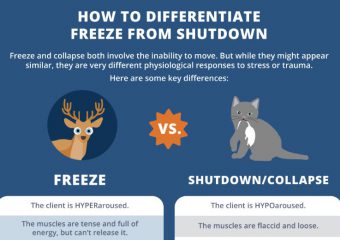
[Infographic] How to Differentiate Between the Freeze and Shutdown Trauma Responses
32 Comments

How to tell the difference between a freeze and shutdown trauma response

The freeze and shutdown responses to trauma can resemble each other . . . . . . but they are very different in terms of what’s happening in your client’s brain, body, and nervous system. And that means they require different grounding strategies as well. In this infographic, we lay out some key cues to […]

  • <
  • Go to page 1
  • Go to page 2
  • Go to page 3
  • >

Recent Posts

  • Hope, Gratitude, and Long-Term Wellbeing
  • Two Telltale Signs of Gaslighting and Manipulation (and How to Address it Clinically)
  • Two Cognitive Restructuring Strategies to Help Disrupt Grief-Fueled Rumination
  • A Gentle Yet Targeted Approach to Help Clients Who Feel Empty Inside
  • A Four-Step Process for Working with a Client’s Shadow Side – with Chris Irons, PhD

Categories

  • Antiracism
  • Anxiety
  • Attachment
  • Body-Oriented Therapy
  • Brain
  • Charity
  • Chronic Pain
  • Compassion
  • COVID-19 Pandemic
  • Depression
  • Emptiness
  • Exercise and Mental Health
  • Fear
  • Gaslighting and Manipulation
  • Grief
  • Healing Trauma
  • Infographics
  • Mindfulness
  • Nervous System
  • Neuroplasticity
  • Perfectionism
  • PTSD
  • Relationships
  • Resentment
  • Shadow Side
  • Shame
  • Spirituality
  • Trauma
  • Trauma Therapy
  • Uncategorized
  • Unworthiness

40 Wilbur Cross Way Suite 102
Storrs, CT 06268
(860) 477-1450

NICABM Logo

About Us
FAQs
Contact Us
Courses
Claim CE/CMEs
Accreditation
ADA Accommodation
Hiring
SITEMAP PRIVACY POLICY TERMS OF USE

CONNECT WITH US

Facebook Logo YouTube Logo Instagram Logo

40 Wilbur Cross Way, Suite 102
Storrs, CT 06268
Phone: (860) 477-1450
respond@nicabm.com
Copyright © 2025