
After trauma, our clients are often left with many painful sensations and emotions . . .
. . . including shame and guilt.
And that’s especially true if they weren’t able to protect themselves or escape.
That’s why it can be so useful to help our clients understand how their brain and body did work to protect them during the traumatic event.
Because when people find out that their response was an adaptive reaction that helped them survive, that can open the door to healing.
So we thought it would be helpful for you to have a way to illustrate this for your clients. (Please feel free to share a copy with them.)
Click the image to enlarge
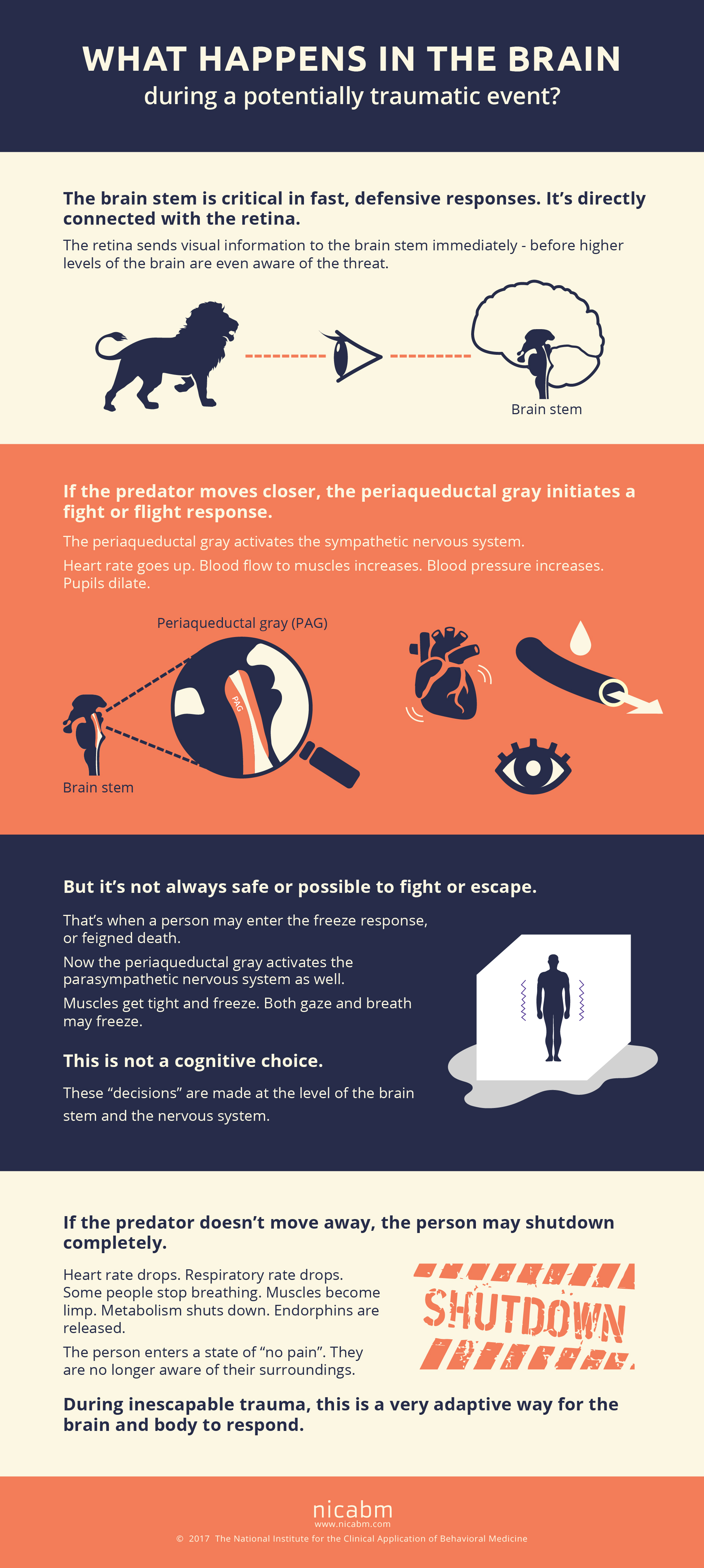
If you’d like to print a copy to share with your clients, just click here: Color or Print-friendly
(Please be sure to include the copyright information. We put a lot of work into creating these resources for you. Thanks!)
If you’re interested in more ways to work with the brain’s response to trauma, you can get some of the top strategies in our Advanced Master Program on the Treatment of Trauma.
In this program, you’ll hear more from Stephen Porges, PhD, along with Bessel van der Kolk, MD; Pat Ogden, PhD; Peter Levine, PhD, Thema Bryant-Davis, PhD, and other leading experts in the field. Just click here.
Now we’d like to hear from you. How will you use this in your work with clients? Please leave a comment below.
Keep up the great work! Very useful info.!
The condensation of the physiologic events taking place in trauma into this 2 page visualization is greatly appreciated! Thank you! I intend to use it to educate and encourage my clients–that what happened to them can first be understood physiologically, and then processed cognitively and emotionally to bring relief.
Thank you so much for all you’ve been offering for clinicians to be more and more effective with our clients! This infograph will be so helpful to my clients who have experienced traumatic experiences, especially sexual molestation, in their childhood, and have a difficult time not blaming themselves for what happened to them. Understanding that their bodies and brains automatically respond rather than there having had a choice, will be helpful.
I will share this graphic with women overcoming sexual assualt, exploitation and/or human trafficking!
There are so many loaded social messages around sexual assualt that this diagram can…and will…open a dialogue of kindness and compassion for ones self…AND for others overcoming their sexually initiated trauma.
Thank you!!
Mary Pichette
Thank you! I enjoyed the webinar and learned a lot. I’m looking forward to completing the series!
I will be more aware of asking the patient to tell me about what she is noticing in her body as we talk about things. To help her be more mindfull and integrate thoughts, emotions and body – while I can support her and be a safe person for her and guide her.
This will hekp me in my work with younf people with additional learning needs – clear, simple, visual information which promotes self-knowledge and compassion.
Is this new information- (the info-graphic about trauma) being utilized in the trials and testimonies concerning Brett Kavanaugh and other rapists?
Also, has the discovery of microchimerisms brought light to accurately pinning rape or sexual abuse on the perpetrator? The science is good to know, but has not seemingly been presented in this worldwide confrontation.
I will use this information as a tool for my clients to add a level of compassion for their bodies responding in a natural way, rather then their bodies betraying them. Any time I can help my clients integrate back into their bodies with compassion is one step towards healing.
These tools and talks are very helpful; thank you for sharing so generously.
What happens to the role of the Amygdala ? I always thought that it was the Amygdala that initiated the fight, flight and freeze reaction. In this graphic it is not even included.
Interesting chart however I think all the senses are involved in this response not just the eyes
Thanks! I’ll use it for my own understanding, and send to a friend who deals with effects of trauma as well. I will keep it in mind when working with my students who have low levels of English but some of whom have come from war zones and other traumatic situations. They’re adults so they may be interested to see and understand this during maybe a unit on health. Take care and thanks again! Rachel.
Thank you so much for these invaluable tools to help in our personal and professional lives. The graphics are enormously helpful!!
My own concern is more with developmental and complex PTS. Hope in the future you do a similar graphic on those two.
Thank you so much for this invaluable graphic! It gives such a clear understanding of how our body’s wisdom protects us during a traumatic event and how we can gently help our clients unravel and disconnect from the event to allow the heaing of their invisible wounds. Thank you also to NICABM for providing the affordable training in the latest trauma research, which I am applying immediately in my practice. My clients are thriving!
Ruth and the whole team , thank you so much again . your translations alsp add so much Ruth/
3 questions.
What senses take over the functions of the visual cortex for people who are do not have sight? HOw is trauma different for them?
Does anyone have access to a well written paper on issues for women who might want or be opposed to nursing their babies if they have experienced previous sexual assault or abuse ?
Given that body and mind are one and the same when do we stop classifying people as mentally ill? When do we start to see people as whole human beings in whom symptoms are manifestations of something/s in the system gone awry ?
Love to hear from Dr Dan Siegel on this. Dan you know only too well the teaching methods at some of the finest medical schools?
You (NICABM) are providing so much more than I ever could have expected. The generosity of this project is stunning ~
As I read the comments this morning, I must add my gratitude to Kevin Haley’s posting. Generosity indeed. This loving, humanitarian gesture helps us “mend” ourselves as we interact with our loved ones – both personal and professional. (I thank the Greek philosophers for the description of the kinds of love we have between any two people.) Professionals who share their knowledge on the platforms of the 21st century give me hope for the future.
This particular video is FULL of practical knowledge. Repeating it on a second day and offering it so freely – awesome gift to the world.
I am so grateful of how you are sharing all your of knowledge with us.
I am a clinical psychologist and treat trauma both in individual therapy and through group therapy.
The client/patient and I always go through a phase of psychoeducation so that they can understand what happened and qhat is going on in their bodies because of the traumatic experiences.
This part of treatment is very helpful and I noticed it brings my clients a sense of relief and control over their bidily sensations and reactions.
¡Muchas gracias from Costa Rica!
I am deeply appreciative of the quality and accessibility of the information that you have presented in the webinar and am delighted with this infographic you have sent to us. I think the pioneers of psychology, like Freud and Jung, would have been so excited with the findings of neuroscience – which actually confirm and give scientific basis to many of their insights into the psychology of the human being. My practice will certainly be enriched by this input.
I really appreciate for your informative message. It is interesting to see visual graph.
I am a trauma counsellor. Bipolar Disorder is the result of Childhood trauma.
How you would open the door for healing? The treatment protocol …”.
Thank you for a really interesting talk. As a former scientist, it was really great to combine my love of physiology with my practice. This resource is especially useful for explaining to clients what is going on and reducing the guilt or blame they may be feeling after trauma.
Very clear and very respectful illustrative cartoons. More efficient than words. Thanks
Thamk ypu so much thiscis amazing information and will really enhance the way I work, helping them further to realize their brain adaptation was a protection at the time of trauma. Really appreciate this course. Ann
This is very useful. Thank you. JC Belsten
I need a helpful response when I hear people say things like “s/he chose drugs.”
Your article is very informative and thanks for allowing me to print it.
Making the client aware of the autonomous response in the brain to over-riding survival.
Thank you for this visual. It is very interesting to see, but I still have a few questions about what happened to me and my brain during the coma.
The fact that I am working with a MeToo who was only 7 is more than I ever could have imagined.
Information sharing with colleagues
Our centre provides Aboriginal early year services we have a number of children in out of home care and families affected by family violence – it will be useful to build program and esources for staff and management
The visual graph is helpful, however when a client is in acute distress,
He/she may not be able to make much sense of how or why this is helpful.
The graph does make a lot of sense.
Well done.
I’m an outpatient alcohol and drug counselor, inspired by the work of Gabor Mate, retired MD, in my work with my clients. Substance addiction is rife with shame and guilt, blaming themselves for “choosing” their addiction over their children or beloved family members. I hope to be able to use this, and other information, to show 1) how they didn’t choose their addiction and 2) how they didn’t choose their addiction over their children and family members. Indeed, it was their need to survive childhood trauma, whether they are immediately aware of that trauma or not, that “chose” their addiction, not them. I look forward to the whole Treating Trauma Master series to help clients eliminate their shame and guilt through understanding the source of their addiction, and, as Dr. Mate states, become more responsible for their lives, and recovery, now.
Im interested in multiple traumatic events and the effect that has on the brain as well as generational trauma.
This is god information.
I really appreciate the visual graph – a very helpful resource for clients. Thank you!
Thank you for this excellent resource
I am looking for research or requested research on trauma and trauma
therapy. I am a swim instructor with a bachelors in psychology currently seeking my MFA in creative writing: dual genre: fiction and non-fiction.
My next semester my thesis is going to be a curriculum for swim instruction working with clients with PTSD. My research needs are obvious. I need behavioral adaptations in treatment and instruction when PTSD is a factor. The applications for veterans, special needs, natural disaster and accident victims, clients facing a chronic , acute or terminal illness and even as skills to help people to cope with the stress and strain of everyday life. I feel my research is timely, and will eventually create a new treatment protocols. Any guidance, or relevant research you can provide, is greatly appreciated. Also, I am looking for guidance concerning funding, teaching fellowships, publishing opportunities, and other ways to fund my work, so I can continue uninterrupted, this important journey towards better treatment protocols for clients with trauma.
Melody Ann Penney, in response to your request, just a detail to consider. You didn’t mention rape survivors among your planned swim students with PTSD, but since an inclination towards PTSD often has roots in childhood PTSD response, some people who come to you for the kinds of causes you listed may also have childhood sexual abuse trauma. Women with that kind of history may feel too vulnerable having their bodies exposed in a regular bathing suit while addressing PTSD, so you may want to give the ladies permission to wear less-revealing clothing (such as burkini swimwear) if it will make them feel more comfortable.
Fascinating!
Am I wrong in thinking that the dorsal vagus nerve is involved in the freeze response?
Do not feel that it is your fault. It could probably be something that was passed on …but you are a person that believes in God, hence your prayer. I pray with you that you and your daughter will be freed of this trauma.
The shutdown state sounds very similar to some very deep states of meditation. I wonder whether there is any correspondence in brain functioning between the two states.
I’ve spent a fair amount of time dissociated, and have had multiple traumatic experiences during which I froze. I also have gone through phases with an intense and regular meditation practice. Shutting down very very very different to me than being in a deep state of meditation. They are not the same at all.
When I am frozen my body is in one place and *I* am above it. When I’m not frozen, but have disassociated (even just a little) I feel like the real me is bouncing along a little above my body. When I am frozen or have disassociated it’s usually because I’m completely overwhelmed by something. In those moments I’m escaping without leaving where I am–I’m leaving my body but my body isn’t going anywhere. I am *not* experiencing whatever is happening in/to my body in those moments. I’m *watching* what is happening, but I’m not feeling much of anything.
When I am in a deep state of meditation my body and I are very much together. During meditation my body and I have a different relationship with each other in the moment than usual, but we do have a relationship at that point. I haven’t abandoned any part of myself– quite the opposite–the practice of meditation *allows* ALL OF ME (including my body) to experience everything that comes in the moment. During meditation I often have BIG emotions and sensations come up. I feel them intensely, but somehow they don’t overwhelm me to the point that I need to escape. (For the record, I don’t understand that part–but I have learned to trust that it will be OK to allow what comes up when I’m a deep state state of meditation. It’ll be A LOT, but it won’t be too much. I don’t know how or why that is. It just is.)
In fact, when something has happened that has caused me to disconnect with my body, meditation is often how I manage to get back into my body. (This works even when I don’t know why I have disconnected from my body.) I find a place where I feel safe and am alone and have time. I start by just focusing on my breath. And then when I’m ready (and it feels right) I start scanning my body–sort of wordlessly asking it what it has to say to me. I pay attention to whatever part of my body is calling to me. There’s usually one part of my body that needs the most attention. I focus my attention there–just very intentionally experiencing what is happening in that part of my body. It’s usually not pleasant. Big emotions usually come up. And I *allow* them. They generally aren’t fun. But it’s worth it to get back into my body.
I will also say that I had a therapist who spent a fair bit of time talking to me about my meditation practice. I think she was trying to figure out if what I was calling meditation was really dissociation. She seemed satisfied when it became clear that the practice was bringing me into my body–not separating me from it.
This is a fantastic description of how self care and attention is a direct path of empowerment for healing. Thank you for your courage to share this technique. I expect there is a neurological component in using the bodyscan to reintegrate consciousness and deliberately reawaken and connect parts of the brain that dampened down during trauma coping periods. Thank you for sharing.
Thanks for your discernment. It is very helpful for me, and I am sure for others as well. Also I am grateful for your technique of listening to your body and sensing where it speaks most to you.
and for listening to the feelings that come up. This is useful.
thank you for the reprint. Visuals are always appreciated for teaching purposes.
It’s really helpful to have a succinct, clear explanation that clients can take away to understand and remind themselves of what trauma does, so that self blame and shame can be alleviated.
I think this information will be empowering in knowing that adaptive responses were at work.
My clients are always very appreciative of learning about the role of the brain and endocrine systems in trauma and how their response was actually adaptive. It helps to begin recovery. Thanks!
I work with children and adults who have suffered trauma and all insights are helpful, particularly where the children have been misdiagnosed. Thank you for your helpful insights!
Thank you so much for these tips, they are incredibly helpful and I am looking forward to listening in to the series in November.
Be well,
Noel
Thank you for this wonderful series.
Do you support offering or suggesting non-verbally to the patient attachment to Self as a safe attachment approach?
In my work as a Bodywork practitioner I feel very responsible for the non verbal impact I’m creating in the world, and I will appreciate your input on this. I stumbled on trauma stored and released in the body for 25 years; I had to take millions of classes (under the suggestions of the psychology professionals I work with) on Somato-emotional Release, Psychodrama, other PTSD approaches etc., in order to feel capable of offering a safe first response to the patient. Trauma shows up in a Bodywork session inevitably, so I had to learn a safe first-response strategies. I have found that if I manage to facilitate a still-point non verbally- through CST or Visceral Manipulations and enhance this with the patient creating his Dance-Life-Map(non-verbally, again) during the session, he/she is less likely to seek safe attachment to external source. In my work with cancer survivors, I found that using apilado-style Tango helps them to regain faster their eroded sense of self-trust, nonverbally. These patients’ mental health professionals report that they achieve lower levels of state anxiety , trait anxiety and pain faster.
I suffered an unimaginable amount of violence and trauma and kept all of this to myself… when my only daughter was born I prayed that she would never suffer as I did… when my daughter was diagnosed with RSD/CRPS the most painful condition in medicine I knew it was all my fault! The damage to my brain without a doubt affected her central nervous system… overcome with guilt daily.
I question the statement “I knew it was my fault”. “Knew means that you have verifiable evidence and “fault” suggests that you were intentional or negligent.
Beloved, I am so sorry you have had this burden. We have no idea how your trauma affected your sweet baby, but you are not responsible for that. What you endured (alone and unaided!) May give you strength to be present for your suffering child. I honor you for being here, looking for answers and help. I am not a health professional, I am a witness to what you are sharing.
I work with women who have experienced trauma when discovering their husbands are viewing pornography. Many have been told they have PTSD and do experience triggers as I did, even years after the initial discovery.
I want to learn everything I can to help these ladies become free of the trauma that keeps them from moving forward in their lives. This information and graphic even helped me experience a new level of freedom from the shame.
Do you know about APSATS?
Thank you Ruth, the diagram is really helpful to explain to clients so they can begin to feel less ashamed and guilty about their feelings of helplessness after trauma
Aside from education I would try and empower the client to find ways of escape that are safe and I will help the client identify his/her social support network.